The default should be to buy
An existing assessment platform has already solved the hard, unglamorous parts: authentication at scale, persisting attempt state through a dropped connection, automatic marking, report generation. That is thousands of engineering hours you do not have to pay for twice.
Building only makes sense when there is a specific reason not to buy, and that reason has to be sayable in a sentence. If the only reason is "we want control", it is not yet a reason.
Question 1: Is your process genuinely different?
This is the most important question and the easiest one to answer wrongly. The test: write out your current assessment process, then mark the steps a mainstream platform does not support.
If that list is empty, or only contains differences in labels and layout, you are describing a need for interface customization, not a need for a new system.
- Does your paper structure fall outside the common response types?
- Are your scoring rules more complex than adding up marks per item?
- Does your paper approval workflow have levels an existing platform cannot express?
- Do results have to feed an internal system that already exists?
Question 2: Is the sitting experience your differentiator?
For a school running internal exams, the sitting experience is not the differentiator. For an organization selling exam practice, it is the product.
This is the clearest line between the two groups. When the assessment interface is what customers pay to use, customizing it deeply on somebody else platform usually costs more than building it.
Question 3: Where does your data have to live?
Some organizations have specific requirements about where candidate data is stored, or that it must not leave internal infrastructure. That requirement narrows the list of usable off-the-shelf platforms considerably.
If you have a constraint like this, raise it in the first conversation. Discovering it late during implementation is one of the most common reasons a project has to start over.
Question 4: Who operates the system a year from now?
Building does not end at handover. The system needs someone to maintain it, update content, handle incidents during a live session, and fix defects. If your organization has no plan for that, the real cost of building is higher than the contract figure.
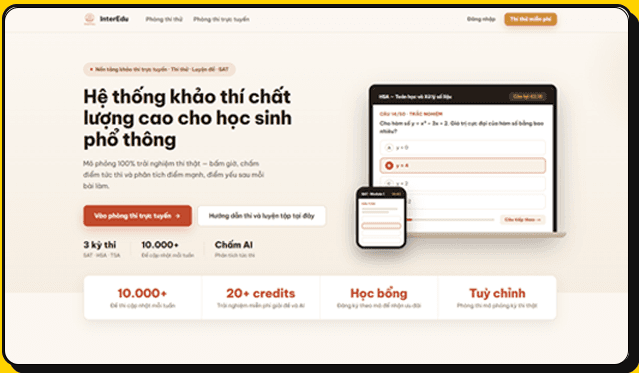
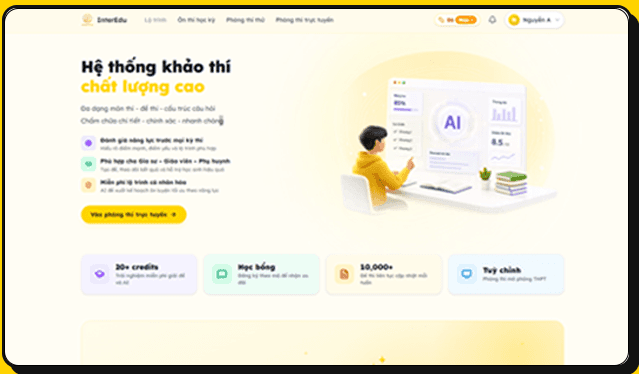
This question also has a third answer: build it, then take a technology transfer with documentation and training so an internal team takes over. That is the model InterEdu works toward, and it only works when the organization has, or is willing to build, internal technical capacity.
Reading the result
Four noes: buy an existing platform. A yes on question 1 or 2: building is defensible. A yes on question 3: your shortlist narrows and each candidate platform needs checking individually.
One middle path is usually overlooked: start with one real exam at limited scope, review the outcome, and only then decide whether to expand. That turns a large irreversible decision into two smaller ones.
- No to all four: buy an existing platform
- Yes to question 1 or 2: building has a basis
- Yes to question 3: check storage conditions before shortlisting
- Still unsure: pilot one real exam, then decide