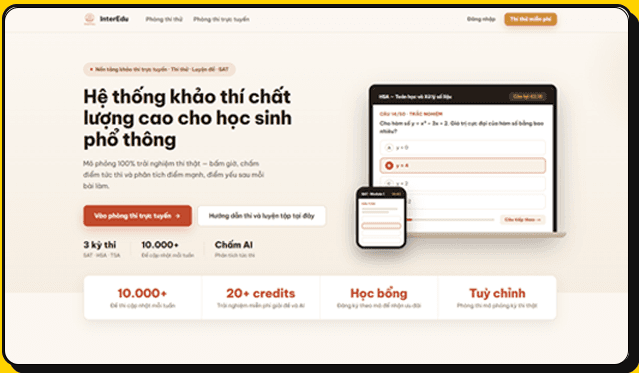
Practice in the right exam context
The environment is structured around competency and thinking assessment formats for upper-secondary students.
dgnl.phongthi.vn models competency and thinking assessment formats so upper-secondary students can practise with direction, review strengths and weaknesses, and refocus the next stage of preparation.
The value is not in completing as many tests as possible, but in understanding what each result says about the preparation journey.
The environment is structured around competency and thinking assessment formats for upper-secondary students.
Strength and weakness analysis helps learners see what is secure and what deserves more attention.
Each attempt informs the next focus, allowing the learner to return for another round with clearer intent.
This flow shows how an exam target becomes a practice action, useful feedback, and a clearer next step.
Select a stage in the flow to read the details.
Start with the assessment the learner is working toward, not a generic set of exercises.
The learner identifies a relevant format from HSA, TSA, SPA, BCA, QDA, and VACT. A clear starting point gives every practice attempt the right context.
Experience a practice test within the selected competency or thinking assessment context.
The platform gives upper-secondary students a space to become familiar with and practise in a modeled setting. Each attempt becomes one observation point in the wider preparation journey.
Move from an overall result to the areas that deserve the learner's attention.
Result analysis helps the learner see the relationship between stronger and weaker areas. The information becomes a direction signal, not only a score.
Translate the analysis into a practical learning choice for the next stage.
With the result in view, the learner and guide can prioritize areas to strengthen, maintain progress elsewhere, and reorganize the practice plan.
Return for another round and continue reading results in the same target context.
The journey works as a loop: practise, read, refocus, and practise again. That gives every attempt a role within a longer preparation process.
The platform creates a shared language for learners, guides, and organizations running competency assessment practice.
Need to practise the right format and know which areas to prioritize.
The result becomes a guide for the next stage of preparation.
Need a view that supports conversation beyond the total score.
Strengths and weaknesses provide a basis for suggesting the next focus.
Need a practice environment connected to the target exam format.
See preparation as a purposeful process with a feedback loop.
The product scope centers on the formats named in the profile and the ability to analyze strengths and weaknesses.
Practice contexts for two featured competency and thinking assessment formats.
Extend preparation to additional target assessment formats.
Add further choices so learners can approach the format they are preparing for.
Turn a practice result into a directional signal for the next plan.
A meaningful practice program first defines what learners are preparing for and how the results will be used.
Clarify the audience, assessment format, and purpose of the preparation period.
Handoff: Practice contextPlan how learners will approach modeled tests and read the feedback after each attempt.
Handoff: Experience scenarioRun a practice cycle so learners and guides become familiar with the flow.
Handoff: First practice cycleAlign on how strengths and weaknesses inform the next round of preparation.
Handoff: A repeatable usage processThe published scope includes HSA, TSA, SPA, BCA, QDA, and VACT for competency and thinking assessment practice by upper-secondary students.
The available information confirms strength and weakness analysis. Any score conversion, prediction, or deeper advisory method would need to be clarified for a specific program.
The platform is presented as a practice environment for upper-secondary students. The delivery scope, content, and operating model can be discussed around each organization's needs.
Share the learner group, target format, and how you want to use the results. InterEdu will help outline a relevant practice flow.