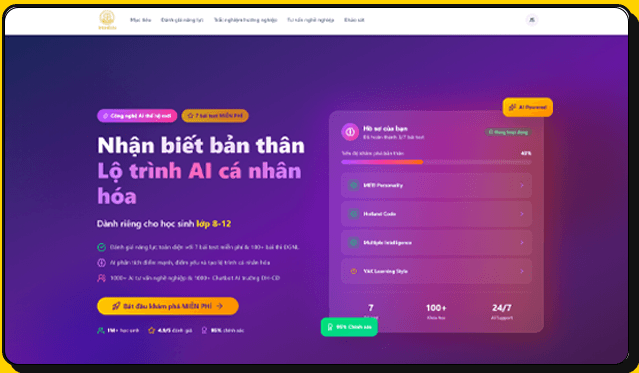
See the self through multiple lenses
MI, MBTI, and Holland sit alongside personal and career values to provide complementary perspectives.
conghuongnghiep.edu.vn connects self-discovery, personal values, admissions information, and goal-based pathways so students can understand themselves before choosing a direction.
The platform helps students move from “Who am I?” to “What should I explore and prepare for?” without turning one assessment result into a final decision.
MI, MBTI, and Holland sit alongside personal and career values to provide complementary perspectives.
Admissions information lookup places self-discovery within the context of learning choices.
Goal-based pathways move career guidance from reflection toward the steps a student can prepare for.
The flow does not decide for the student. It organizes signals so learners, families, and guides can see the situation more clearly together.
Select a stage in the flow to read the details.
Begin with MI, MBTI, and Holland perspectives instead of choosing a career immediately.
Students approach several discovery frameworks to notice interests, tendencies, and ways they engage with learning and the world of work.
Place personal and career values alongside the discovery results.
A fitting choice depends on more than ability or interest. Reflecting on values gives students another set of criteria for comparing possible directions.
Read the results as pieces of a picture, not permanent labels.
MI, MBTI, Holland, and values sit alongside one another to form a multi-dimensional view. This is input for a guidance conversation, not a verdict that replaces the learner.
Place self-understanding in the context of fields of study and admissions information.
Students use the portal to explore relevant admissions information, then test an area of interest against the facts needed for a considered choice.
Turn an area of interest into preparation stages that can be followed.
From a chosen goal, students can envision an admissions pathway and the learning steps they need to prepare for. The pathway can continue to evolve as their understanding changes.
The platform gives students a basis for reflection, families a way to listen, and schools a structure for the guidance journey.
Need to understand themselves before navigating too many options.
Discover, research, and build a pathway instead of receiving an imposed answer.
Need a shared language for discussion without deciding on the student's behalf.
Use the signals as a starting point for questions and support.
Need a structured career guidance journey for students.
Connect self-discovery, admissions information, and goal-based pathways.
Each layer answers a different question and together they create a career guidance journey for the student.
Provide multiple reference frames for students to explore themselves from different angles.
Add criteria around what matters to the student when considering a direction.
Place self-discovery within the context of learning and admissions choices.
Turn an area of interest into preparation steps that can continue to evolve.
The implementation starts with the age, context, and real questions of students so each activity connects to what comes next.
Clarify the age, decision stage, and guidance objective of the program.
Handoff: Guidance contextSequence self-discovery, conversation, research, and goal-based pathway building.
Handoff: Experience scenarioHelp students move through one cycle and understand how to read the signals about themselves.
Handoff: First guidance cycleAlign on how the school can continue using the journey with future student groups.
Handoff: A maintainable guidance processA single assessment result should not be treated as a final decision. These frameworks provide reference points for self-discovery and further conversation with family, school, or a guidance professional.
No. The published scope also includes personal and career values, admissions information lookup, admissions considerations, and goal-based pathways.
The career guidance portal is presented for lower and upper-secondary students. The journey should be adapted to the age and decision stage of each group.
Share the age group, decision context, and current guidance model. InterEdu will help outline a relevant journey.